
No more impression trays
Crowns, bridges, dentures, night guards and clear aligners all need an exact record of your teeth. Traditionally that meant a tray of putty held in the mouth for several minutes while it set — uncomfortable, and a common trigger for gagging.
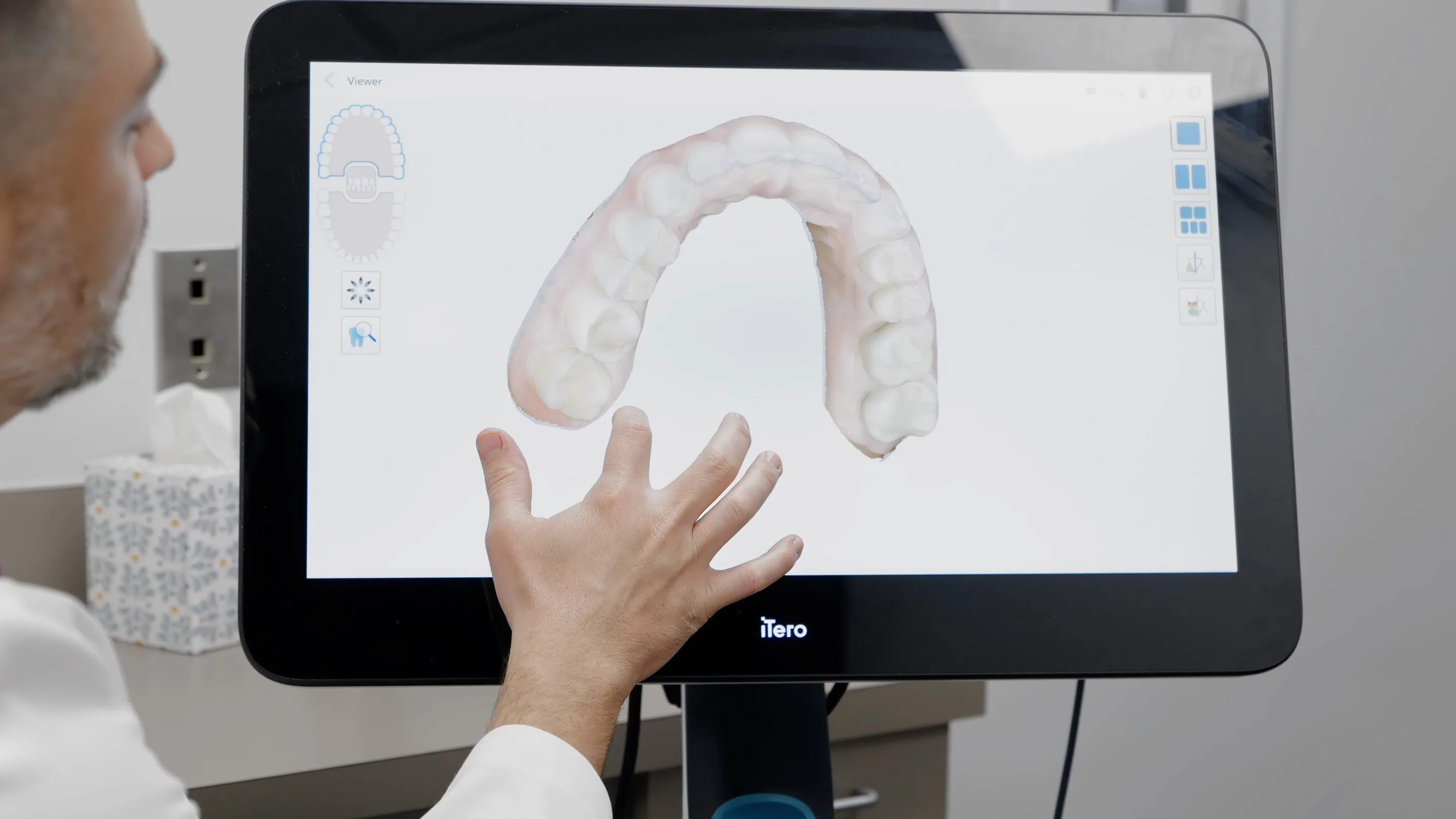
A digital scanner replaces it with a small wand that photographs the teeth thousands of times as it passes over them, stitching the pictures into a 3D model on screen as it goes. It is optical, working with light rather than X-rays, so there is no radiation involved.
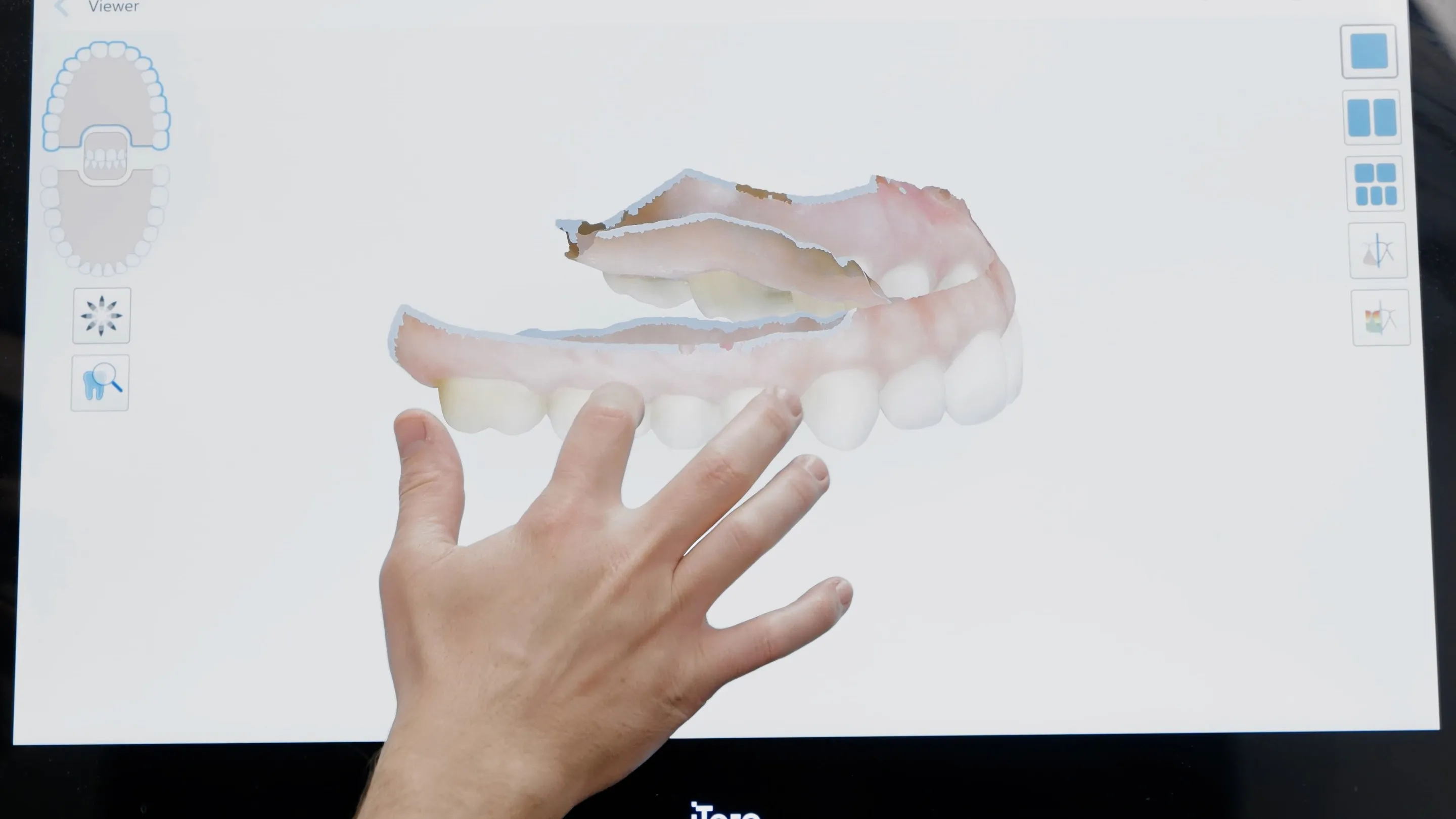
A restoration is made to fit the model, not the tooth. If the record is distorted — and putty can distort as it sets, when it is removed, or on its way to a laboratory — the crown or appliance that comes back may not seat properly, and the appointment has to be repeated.
A digital scan can be checked on the spot. If part of it is incomplete or unclear, that area is rescanned in seconds rather than starting the whole impression again. The file is then sent to the laboratory electronically, so there is no physical model to be damaged in transit.
For single crowns and short bridges, research generally finds digital impressions at least as accurate as conventional ones. For some larger or more complex cases a conventional impression is still the better choice, and a dentist will use whichever suits the work.
What it is like
- You sit back in the chair as for any appointment. The teeth may be dried with a gentle stream of air, since moisture can blur the scan.
- The wand — about the size of an electric toothbrush handle — is moved slowly over the teeth and gums. You can breathe, swallow and talk between passes.
- The model builds on the screen as it goes. Nothing sets, nothing has to be held still in your mouth, and you can ask to stop and take a break at any point.
- The finished scan is checked, any gaps are filled in, and it can be shown to you before you leave.
Seeing your own teeth in 3D
A 3D model of your own mouth is an unusually clear way to understand what is going on. Worn edges from grinding, a tooth that has tipped into a gap, or gums that have receded along one side are much easier to see turned and enlarged on a screen than in a hand mirror.
For clear aligners, the scan is also the starting point for planning how the teeth will move. Saved scans give a baseline too: comparing one with the next can show whether wear or movement is progressing, which matters when deciding whether a night guard or other treatment is worthwhile.

Frequently Asked Questions
Does it gag you like putty?
Far less often. There is no material filling the mouth and nothing has to be held in place while it sets — just a small wand passing over the teeth, and you can pause whenever you need to.
How long does a scan take?
It depends on how much of the mouth is being recorded. A scan of one area for a single crown is quicker than a full scan of both arches for aligners, but in most cases it is a matter of minutes.
Can I see the scan?
Yes. The model builds on a screen as it is captured and can be turned and enlarged afterward, which makes it easy to show you what is being discussed.
Is it more accurate than a putty impression?
For single crowns and short bridges, digital impressions are generally at least as accurate as conventional ones, and a missed area can be rescanned in seconds instead of repeating the whole impression. For some larger or more complex cases a conventional impression is still preferred.
Does the scanner use radiation?
No. It is an optical scanner — it works with light, like a camera — so there is no X-ray exposure at all.
What happens to the scan afterward?
It is saved to your record and, where something is being made, sent electronically to the dental laboratory that makes it. Keeping it also gives a baseline to compare against if teeth wear or move over the years.